Introduction
Imagine a regular Tuesday morning. You are rushing to work, grabbing a coffee, and checking emails on your phone. Life feels busy, but normal. Suddenly, a wave of dizziness hits. Your arm feels heavy. The words you try to speak come out slurred. In a split second, life as you know it changes.

This isn’t a scene from a movie; it is the reality of a Stroke.
At Pansuk Insurance, we believe that "Protecting with heart" means more than just offering policies; it means empowering you with the knowledge to live a longer, healthier life. We understand that for many working adults and heads of families, the fear isn't just about getting sick—it's about "Who will take care of my family if something happens to me?"
Stroke is often called a "silent killer," but it doesn't have to be a mystery. While it is a leading cause of disability worldwide, the good news is that up to 80% of strokes are preventable.
In this comprehensive guide, we will walk you through everything you need to know about strokes—from identifying the early warning signs (that could save a life) to practical prevention tips that fit into your busy lifestyle. We are here to be the trustworthy expert you can lean on, explaining complex medical terms in simple, caring language.
Let’s take this journey to better health together.
What Exactly is a Stroke?
To understand how to prevent a stroke, we first need to understand what is happening inside the body. Think of your brain as the command center of your life. It controls everything: your movement, your speech, your memories, and your emotions. Like any command center, it needs a constant power supply. For the brain, that power is oxygen-rich blood.
A stroke occurs when that blood supply to part of your brain is interrupted or reduced, preventing brain tissue from getting oxygen and nutrients. Brain cells begin to die in minutes.
The Two Main Types of Stroke
You might hear doctors use technical terms, but here is the simple explanation:
-
Ischemic Stroke (The Blockage): This is the most common type, accounting for about 87% of all strokes. Imagine a garden hose being pinched shut. An Ischemic stroke happens when the arteries to your brain become narrowed or blocked, causing severely reduced blood flow (ischemia). This is often caused by fatty deposits (plaque) or blood clots.
-
Hemorrhagic Stroke (The Burst): This is less common but very serious. Imagine that garden hose bursting due to too much pressure. A Hemorrhagic stroke occurs when a blood vessel in the brain leaks or ruptures. High blood pressure (Hypertension) and aneurysms (weak spots in blood vessel walls) are common culprits.
There is also a "Mini-Stroke" called a TIA (Transient Ischemic Attack). The symptoms are the same as a stroke but last only a short time. However, never ignore it. It is a major warning sign that a full stroke could be coming soon.
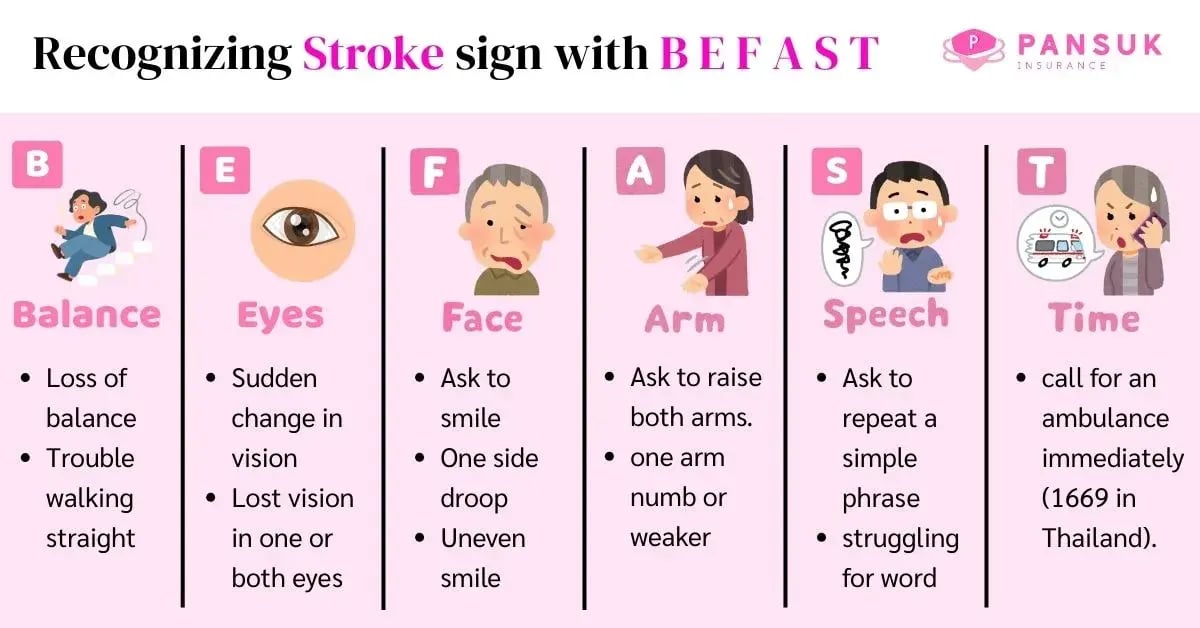
Recognizing the Signs: Act BEFAST
At Pansuk Insurance, we care about your family like our own. If you learn only one thing from this article, let it be this acronym. Time is the most critical factor in stroke treatment. "Time is Brain." The faster you get medical help, the better the chance of recovery.
We use the acronym BEFAST to help you remember the sudden signs:
B - Balance
Does the person have a sudden loss of balance or coordination?
-
What to look for: Are they stumbling? Do they feel dizzy or like the room is spinning? Are they having trouble walking straight?
E - Eyes
Is there a sudden change in vision?
-
What to look for: Have they lost vision in one or both eyes? Is their vision blurry or doubled?
F - Face Drooping
Ask the person to smile.
-
What to look for: Does one side of the face droop? Is their smile uneven? Is the eyelid on one side hanging lower than the other?
A - Arm Weakness
Ask the person to raise both arms.
-
What to look for: Does one arm drift downward? Is one arm numb or weaker than the other?
S - Speech Difficulty
Ask the person to repeat a simple phrase (e.g., "The sky is blue").
-
What to look for: Is their speech slurred? Are they hard to understand? Are they struggling to find the right words or speaking nonsense?
T - Time to Call for Help
If you observe any of these signs, call for an ambulance immediately (1669 in Thailand).
-
Crucial Advice: Do not wait to see if symptoms go away. Do not let the person drive themselves to the hospital. Note the time when the first symptom appeared; this information is vital for doctors to decide on the treatment method.
Who is at Risk? (It’s Not Just Seniors)
Many people believe stroke is an "old person's disease." While age is a factor, strokes are increasingly occurring in younger adults—the working population aged 25 to 45. Why is this happening? The modern lifestyle plays a huge role.
As a brand that understands real life, we know how hard you work. But let’s look at the factors that might be putting you at risk.
Uncontrollable Risk Factors
-
Age: The risk doubles every decade after age 55.
-
Family History: If a parent or sibling has had a stroke, your risk may be higher.
-
Gender: Women have a slightly higher lifetime risk of stroke than men.
Lifestyle Risk Factors (The Ones You Can Change)
This is where you have the power to protect yourself.
-
High Blood Pressure (Hypertension): This is the #1 cause of stroke. It damages arteries over time.
-
High Cholesterol: High levels of "bad" cholesterol can build up in arteries (plaque).
-
Diabetes: High blood sugar damages blood vessels.
-
Smoking: Smoking thickens blood and increases plaque buildup.
-
Sedentary Lifestyle: Sitting at a desk all day (common for office workers) weakens the cardiovascular system.
-
Stress: Chronic work stress raises blood pressure and inflammation.
Prevention: Caring for Your Future Self
Prevention doesn’t mean you have to run a marathon tomorrow or eat only salad. At Pansuk Insurance, we believe in accessible, realistic changes. We want to be your supportive friend in this journey.
Here are practical ways to lower your risk, starting today:
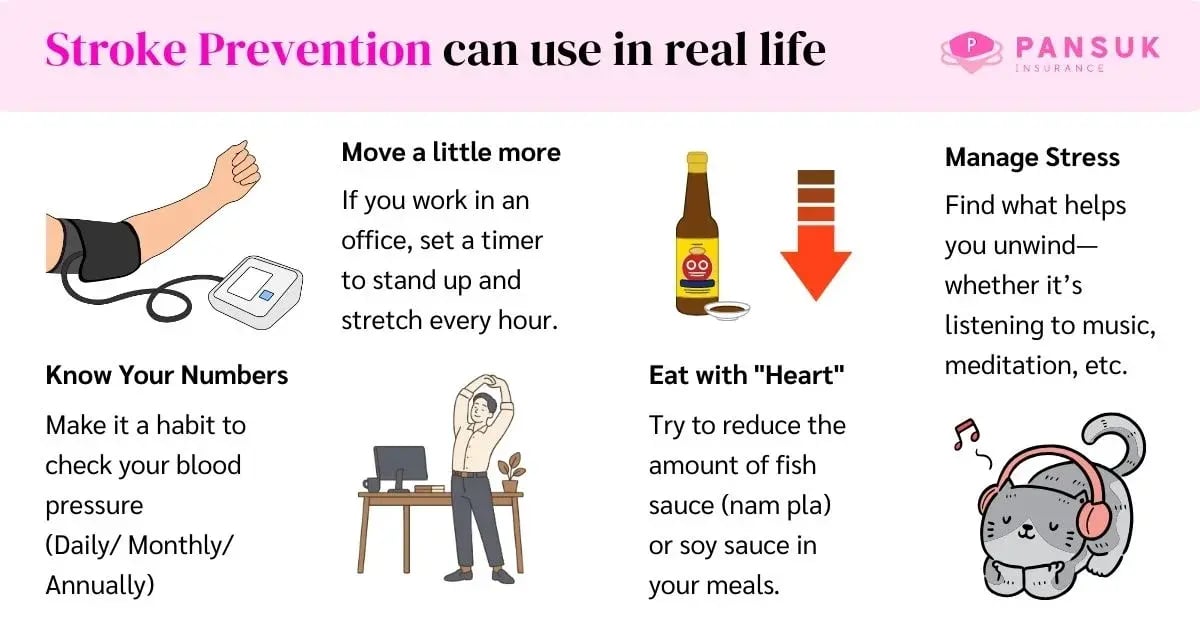
1. Know Your Numbers
You cannot manage what you do not measure. Make it a habit to check your blood pressure and cholesterol annually. If you are a working adult, utilize your company’s annual health check-up.
-
Target: Aim for blood pressure below 120/80 mmHg.
2. Move a Little More
You don’t need a gym membership to be healthy.
-
Tip: If you work in an office, set a timer to stand up and stretch every hour. Take a 20-minute walk after dinner. Aim for 150 minutes of moderate activity per week.
3. Eat with "Heart"
Thai food is delicious, but often high in sodium (salt) and sugar.
-
Adjustment: Try to reduce the amount of fish sauce (nam pla) or soy sauce in your meals. Choose grilled options over deep-fried ones. Eat more colorful vegetables—think of them as natural medicine for your arteries.
4. Manage Stress
We know this is easier said than done. But chronic stress is dangerous. Find what helps you unwind—whether it’s listening to music, meditation, playing with your pets, or spending quality time with family.
Treatments and the Road to Recovery
If a stroke does happen, life is not over. Modern medicine has advanced significantly.
Immediate Treatment
-
For Ischemic Stroke: Doctors may use a "clot-busting" drug (tPA) to dissolve the clot and restore blood flow. This must be administered within a few hours of symptoms starting.
-
For Hemorrhagic Stroke: Treatment focuses on controlling bleeding and reducing pressure in the brain, sometimes requiring surgery.
Rehabilitation: The Journey Back
Recovery is a marathon, not a sprint. It involves physical therapy (to relearn movement), speech therapy (to regain language skills), and occupational therapy (to relearn daily tasks).
This period requires immense patience and support from family. This aligns with our core belief: Caring like family. The emotional support a patient receives is just as important as the medical treatment.
The Financial Reality: Why Preparation Matters
We rarely talk about money when we talk about health, but as a "Trustworthy Expert," we want to be honest and transparent with you.
Treating a stroke is expensive.
-
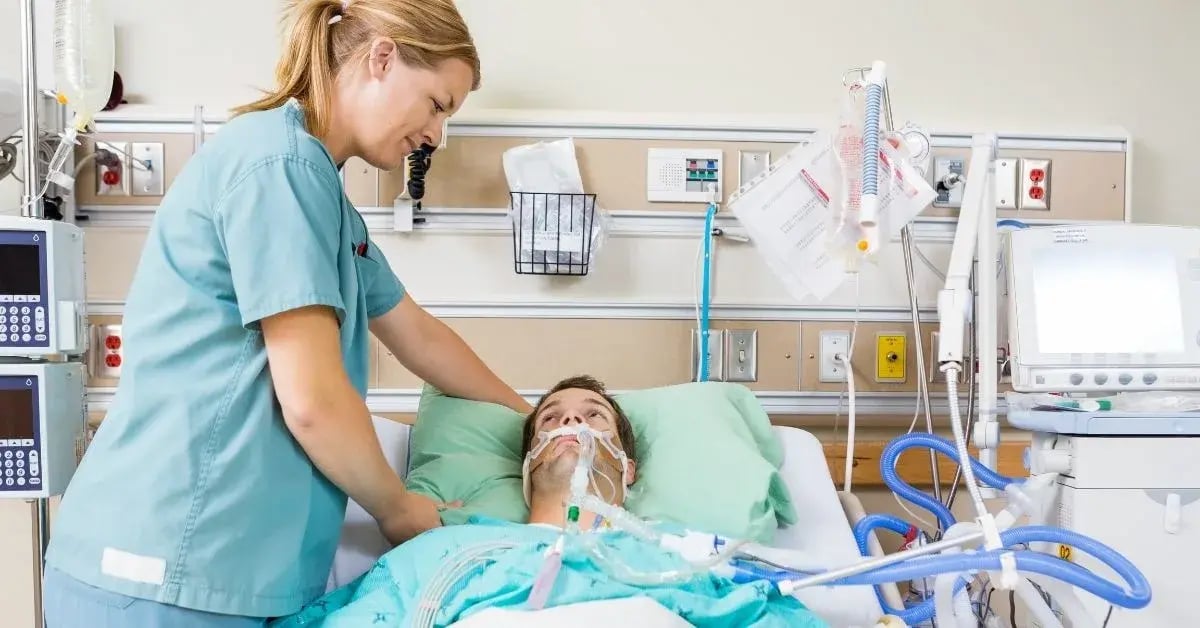
Emergency Care: ICU costs in private hospitals can range from 15,000 to 30,000+ THB per night.
-
Long-term Rehab: Physical therapy sessions, medication, and home modifications can cost tens of thousands of baht per month for years.
-
Loss of Income: If you are the main breadwinner and cannot work during recovery, the financial burden on your family can be overwhelming.
This is where the concept of "Insurance that understands your life" comes in. Many standard health insurance policies cover the hospital stay, but they might not cover the lost income or the long-term rehabilitation costs.
Critical Illness Insurance is designed to fill this gap. It provides a lump sum of money upon diagnosis. This money isn’t just for hospital bills; it’s for life. You can use it to pay off debt, hire a nurse, or simply keep your family’s life running while you focus 100% on getting better.
We aren't telling you this to scare you. We are telling you this because we want you to have peace of mind. We want you to know that no matter what happens, your family is safe.
Conclusion: Your Health is Your Greatest Wealth
Stroke is a serious condition, but it is not inevitable. By understanding the risks, recognizing the BEFAST signs, and making small, positive lifestyle changes, you are protecting not just yourself, but the happiness of the people who love you.
At Pansuk Insurance, our mission is to stand by you—clear, honest, and caring—through every stage of life. Whether it’s providing knowledge like this blog post or designing insurance plans that fit your real needs without complications, we are here for you.
Take a moment today to:
-
Share the BEFAST signs with your family.
-
Schedule that health check-up you’ve been postponing.
-
Review your financial protection plan.
Life is unpredictable, but your peace of mind doesn't have to be.
Are you prepared for the unexpected? Don't let worry cloud your future. If you are looking for advice on health protection or Critical Illness coverage that is honest, transparent, and easy to understand, let’s talk.
We are ready to be the advisor you can trust. 👉 [Click here to consult with Pansuk Insurance experts] (No pressure, just a friendly conversation to help you plan best.)
Frequently Asked Questions (FAQ)
Q: Can stress really cause a stroke?
A: Yes, indirectly. Chronic stress contributes to high blood pressure and inflammation, which are major risk factors for stroke. Managing your mental health is a key part of physical health.
Q: Is stroke hereditary?
A: Genetics play a role. If your parents or grandparents had strokes, you are at higher risk. However, lifestyle choices (diet, exercise, smoking) often have a bigger impact than genetics alone.
Q: Does aspirin prevent strokes?
A: For some people, yes, but for others, it can be dangerous (especially for hemorrhagic stroke risks). Never start a daily aspirin regimen without consulting your doctor first.
Q: How much insurance coverage do I need for Critical Illness?
A: A good rule of thumb is to have coverage equal to 3 to 5 years of your annual income. This ensures that if you need to stop working to recover, your family's standard of living remains unchanged.
Myth Busters: Common Misconceptions About Stroke
Myth: "If the symptoms go away quickly, I’m fine."
Fact: No! This could be a TIA (Mini-Stroke). It is a major warning sign. Go to the hospital immediately.
Myth: "Stroke implies pain."
Fact: Most strokes are actually painless. Do not wait for a severe headache to seek help. Look for numbness, confusion, and loss of function.
Myth: "Recovery stops after 6 months."
Fact: While the fastest recovery happens in the first few months, stroke survivors can continue to improve their speech and mobility for years with dedicated rehabilitation.